Sunday, October 19, 2014

Nelly Walter

In his book The World of the Trapp Family, William Anderson describes the important role that Nelly Walter played in the discovery of the Trapp Family by American audiences. He quotes Walter herself:
It was I who discovered the Trapp Family when I was in Vienna before Hitler marched in. I asked the great Mr. [Francis] Coppicus [agent for Lotte Lehmann] who came regularly to Europe  . . . to do me the favor and listen to the Trapps. I even took a special hall for this audition. His reaction was "How can you imagine that I can bring them to New York with that kind of attire?" I was very disappointed since the Trapps had come to Vienna at their own expense and money was very tight with them.
Walter then turned to Charles Wagner. Agathe takes up the story:
Mr. Wagner, a prominent concert manager in New York City, arrived at our door, asking to hear us sing. We gave Mr. Wagner a little recital, and when we finished, he asked if we could sing the Brahms "Lullaby" for him. Of course, we could, and by the time we sang the last note, there were tears in this distinguished man's eyes.
Despite Georg's misgivings, the family were signed by Wagner for a fourteen concert tour running from the fall of 1938 through March 1939.  Agathe places the signing during the 1937 Salzburg festival. Walter says she softened Wagner up with a carriage horse ride through Salzburg.

Walter's life was perhaps even more full of incident than the Trapps'.

 In 1933 she had to leave Germany for her own safety, because she was Jewish. She went to Vienna and continued her work. While she was there, Miss Walter arranged the first recital tour of Alice Tully. When Hitler invaded Austria, she went to Prague where her friend, famed conductor George Szell was music director of the opera. When the Nazi tide swept over Czechoslovakia, Nelly managed to get to Paris. There she met Francis Poulenc, American composer Virgil Thomson and other prominent musical figures. When the Germans marched into Paris, she and her mother escaped and went into hiding in Marseilles where she was among those captured and transported to a concentration camp. Many difficult years passed before the Americans landed in Marseilles, when she escaped into the hands of the U.S. Army. Nelly worked for them as a purchasing agent in the Quartermaster Corps—the only foreigner and the only female. Her efficiency was rewarded with a visa to America.
Nelly Walter arrived in New York June 11, 1946. Her former boss in Europe, Andre Mertens, (then the vice president of Columbia Artists) gave her a job after she had been in the country only a few days. Her extensive background and experience in classical music made her an enormous asset to the company, and she was given several artists to manage: Munch, Neveu, Kapell, and Leonard Bernstein.

Friday, October 17, 2014

The Trapp Family Sings Bach 75 years ago


War Bonds

I came across an exhibit of Austrian war bond posters today at the Neue Galerie. This poster caught my eye:


(Apologies for the poor quality of the photo).

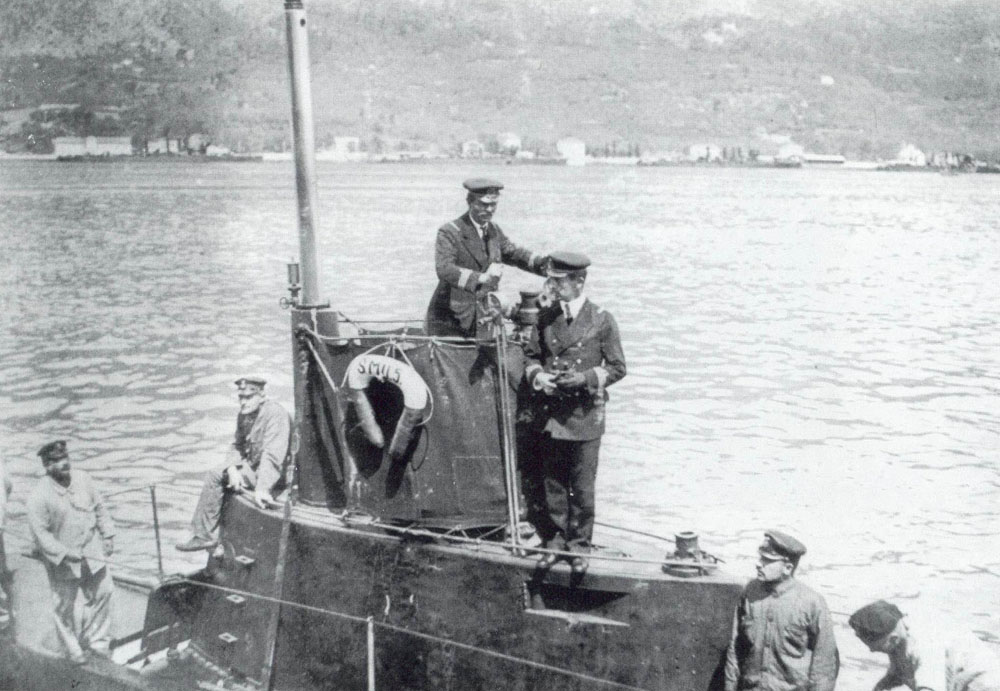
Austria-Hungary began issuing war bonds in November 1914 and did so at six month intervals thereafter. It seems likely this poster dates from the second bond issue in May 1915. This would have been shortly after Georg von Trapp's submarine sunk the French armored cruiser Leon Gambetta. The sinking was an enormous boost to Austrian morale which had been battered by a series of setbacks in the land war with Serbia and Russia. Over 600 French soldiers and sailors were lost. As Agathe wrote:
When the news of his extraordinary accomplishment reached the mainland, Georg von Trapp was considered a hero by the civilian population. Schoolgirls sent him congratulatory letters, and postcards were printed with his photograph and that of the U-5.

Sunday, October 12, 2014

The Trapps Are Coming!!!

In the next few weeks, I'll try and post some news accounts of the Trapps' first months in the United States. Let's begin with a UP story that appeared in 1937 announcing the family's upcoming tour of the United States:

Corpus Christi (TX) Caller Times - October 15, 1937
The same story ran in newspapers in Indiana, Utah  and New York. 

In fact, the first US tour by the Von Trapps was arranged after their Salzburg and Vienna concerts in 1937. According to Agathe's memoir:
A freelance agent named Nelly Walter, who had heard us sing in Vienna, urged her friend Charlie Wagner from America to listen to us during the festival. Mr. Wagner, a prominent concert manager in New York City, arrived at our door, asking to hear us sing. We gave Mr. Wagner a little recital, and when we finished, he asked us if we could sing the Brahms "Lullaby" for him. Of course, we could, and by the time we sang the last note, there were tears in this distinguished man's eyes.
We'll return to Wagner and Walter a bit later. But for now back to London.  The concert at the Austrian Embassy was attended by Queen Mary. According to Agathe, the Queen "listened to us, said a few friendly words, and then left." The Austrian ambassador at the time was the unhappily named Georg von Franckenstein. After the Anschluss, Franckenstein, like the Trapps, abandoned his native country. He accepted British citizenship and a knighthood.


During the war, von Franckenstein was an agent for the OSS. He was urged to seek the presidency of the Second Austrian Republic after the war. He declined and lived in England until his death in 1953.


Sunday, July 6, 2014

Sunday, June 29, 2014

A HIP performance of Sound of Music

Hip as in "historically informed performance." There are certainly hundreds of performances of The Sound of Music in local and regional theaters every year. But I liked this piece about a performance at a dinner theater in British Columbia. The actress - Katie Collins - sought to base her portrayal on the real Maria von Trapp. From the article:

What Collins learned from the autobiography was the real Maria wanted to be faithful to God.
“She never imagined falling in love and getting married,” Collins explains.
“It’s really a revelation for her when Mother Abbess suggests that she can fall in love and get married and love God completely. That tension is probably the most interesting for me in her character.”
In Act Two of The Sound of Music, Collins says you can see Maria grow up.
“She takes her spunk and tomboyishness and helps the captain lead his family to safety. And maybe that’s what she was called to do all along. Maybe that’s what God was leading her towards.”

Saturday, May 31, 2014

Anderson/Brahms

Marian Anderson performing Brahms Alto Rhapsody with Eugene Ormandy and the Philadelphia Orchestra in 1939.


An Ordinary Couple


In case you've forgotten.

Miscellany

Some recent (and not so recent) web items on the Trapps:

An interesting piece on Rosmarie Trapp and her life in Israel. Her thoughts on life as part of the Trapp Family singers:

First of all, we never went out running to the field and singing songs like that. . . .We had a very hard life for the most part. It was a struggle. . . .Money was shared. No one had private money of his own. This way of living, of so many people as a single unit, was not easy. We sewed our own clothes, we dressed in the Austrian style, we didn't go shopping. 

A touching post by Bettina Hoerlin whose mother was forced to emigrate from Germany to Austria and ultimately to the U.S. She describes a reunion with the von Trapps in the U.S:

"The joy of the reunion was palatable (and even photogenic).  The  Trapps encircled my mother, hoisting her up with glee.  It was a celebration of friendship but also of the heady feeling of freedom from terror.  I could envision them all bursting into song – perhaps some kind of  Rodgers and Hammerstein rendition of “America, the Beautiful.”  If only the movie could have ended that way."


Check out the book

This piece by Linda Radtke is my favorite. Here's an excerpt:

"When I heard that Maria Franziska von Trapp, the last surviving sibling of the original Trapp Family Singers, had died, I dusted off the old LPs they made for RCA Victor from 1938 to 1956 and took a fresh listen. The great choral conductor Robert Shaw, mentor of Vermont’s Robert De Cormier, once called these singers “the greatest choral group in the history of recorded sound.” And, despite surface noise like frying bacon on these old recordings, the reason why remains crystal clear.


What I hear above all is an amazing purity and joy, a unison that seems effortless. Yet that apparent ease was the result of tireless work, daily rehearsals, and the genius of their music director, Franz Wasner – a brilliant arranger who came to the family initially as a Roman Catholic priest and led them on their many concert tours in the 40s and 50s.
Without question, their chosen repertoire advanced choral music in this country. Before the revival of “early music” in the 60s, the Trapp family brought Palestrina and Praetorius to concert halls across America. Young Maria played viola da gamba or tenor recorder and sang second soprano."


Marian Anderson

What's the connection?

According to Agathe's memoir, the Trapp family once performed at the same concert hall - but on a different stage - as the famed contralto. Here is her description:

We sang again twice in Vienna [in the 1936-37 season], and while we performed in the small concert hall, the famous American contralto Marian Anderson sang in the large hall in the same building. During the intermission, reviewers wandered over to see what was going on at our concert and what this dirndl-clad family was all about.

According to Agathe, the critics were "delighted" with what they heard in the small hall and sang the praises of "das holde Wunder der Familie Trapp." Or the "lovely miracle" of the Trapp family.

Some context. Anderson had come to Austria the prior year (1935) with the intention of performing at the Salzburg festival. According to this excellent biography, she was sponsored by the Archbishop of Salzburg but was denied an invitation to perform at the Festival. Her manager vigorously protested her exclusion, writing:

When every summer, singers of different nationalities appear in Salzburg, and when Marian Anderson is known throughout the world as one of the finest and most distinguished lieder singers . . . all the more must we be given a reason why permission [for her to sing] has not been granted. [I wonder] whether it is perhaps her dark complexion?

After his complaints, a concert was arranged at the Mozarteum, although not as an official part of the festival. The New York Times reported the climb down as part of an article headlined: "Idiom of Times Square Rules in Salzburg." Reviewing her performance on August 28, 1935, the Times noted: "The disturbances which in the past two months were alleged to threaten if a colored artist chose to tempt fate by giving a concert were not even hinted this evening." Herbert Peyser, the Times critic,  added:
One was persuaded afresh that Miss Anderson is not only one of the greatest living singers but that even with whatever flaws and racial peculiarities her vocalism may disclose, she has exceedingly few rivals in point of schooling, virtuosity and ability to encompass the grand manner.
The performance so impressed the audience and critics that a second recital was arranged at which Toscanini and Bruno Walter were present. Both came backstage to congratulate Anderson. Toscanini said: "What I heard today one is privileged to hear only once in a hundred years."

After a return to the U.S., which included a recital at the White House for the Roosevelts, Anderson again toured Europe in 1936, beginning in Spain which was on the brink of civil war. Her Vienna performance noted above - with the Vienna Symphony conducted by Bruno Walter - included the Alto Rhapsody by Brahms. The Times again was lavish in its praise, noting that one Vienna newspaper had commented, "what would Brahms have said if he could have known that his rhapsody would be sung by a Negress?" The Times rejoined:
Well, Brahms would probably have been overjoyed could he have heard how she sang it - with what intuitive grasp of its poignantly human message . . ..
Aside from the unintended boost that Marion Anderson gave to the Trapp family, her travails show that the Salzburg festival in the mid 1930s - indeed all of Austria - was the center of a political and cultural struggle between the totalitarians and the defenders of a more open society. The Salzburg festival attracted dozens of artists who fled or left Nazi Germany - like Bruno Walter and Lotte Lehmann - or who refused to perform there - like Toscanini. And then there was Marion Anderson who struggled to get a hearing both at Constitution Hall and in Salzburg.

And it was in the midst of this struggle, at the Salzburg festival in 1936, that the Trapp family first performed. When the forces of racism and totalitarianism finally triumphed in Salzburg and Austria in 1938, the Trapps, like hundreds of other artists before and after them, were forced into exile.


Nonnberg

Nonnberg, of course, is the abbey where Maria Kutschera was a candidate before leaving to tutor with the von Trapp family. Her pupil was her future stepdaughter and namesake Maria Franziska. According to Agathe von Trapp's memoir - Memories Before and After the Sound of Music:
The doctor had recommended that this particular teacher [Maria] should leave the convent for a year and get a job because of constant headaches. He felt that her headaches were caused by the sudden confining life she had to lead in the convent. Papa hired Gustl [Maria's nickname] on the spot, sight unseen.
In her own memoir, Maria described herself as "among the lowest of the low" at Nonnberg "the first Abbey of Benedictine Nuns north of the Alps, a place of unearthly beauty."

The abbey was founded in the eighth century by St. Rupert, who was also the founder and patron saint of Salzburg (and gave his name to the eldest von Trapp child). Its first Mother Abbess was Saint Erentrudis. She was a niece of the founder. Maria and Georg named their first child Rosmarie Erentrudis. Residents of the Salzburg area pray to St. Erentrudis for relief from migraines - and this may further have endeared her to Maria.

According to one source, a thirteenth century abbess named Diemut allowed the sisters to slip "into worldly habits in terms of their hair cleansing and grooming." Needless to say, this could not be tolerated for long and "Archbishop Ladislaus saw this manifestation of vanity was put to an end." Sound man, Ladislaus.

I particularly enjoyed these two videos of the abbey:


I can only provide the link to the second video. But I love the Mother Abbess in sunglasses. What would Archbishop Ladislaus think?


Monday, May 26, 2014

A Family on Wheels

Maria Trapp published this book in 1959 - perhaps to capitalize on the debut of the Broadway production that year. Lotte Lehmann - who discovered the Trapp family - wrote a jacket blurb. "If a book can make one both weep and laugh - what more can one ask?" Two selections are worth quoting:
All in all we visited the Deep South many times - enough to realize that the valley of separation still waits for a bridge, and to pray for a bridge where none exists so far. But in those early days we could only drive on in the bus, bewildered by a side of life which, as Europeans, we did not understand, and as Christians we could not approve.
And on being a refugee:
A refugee is not just someone lacking in money and everything else. A refugee is vulnerable to the slightest touch: he has lost his country, his friends, his earthly belongings. He is a stranger, sick at heart. He is suspicious; he feels misunderstood. If people smile, he thinks they ridicule him; if they look serious, he thinks they don't like him. He is a full-grown tree in the dangerous process of being transplanted, with the chance of possibly not being able to take root in the new soil. 

Chicago

The Lyric Opera's production of The Sound of Music just finished its run. It was beautifully staged and wonderfully sung. Particularly strong were Jenn Gambatese as Maria and Christine Brewer as the Mother Abbess. Also very fine were Billy Zane as the Captain and Elizabeth Futral as Elsa Schraeder. One unfortunate omission from the production was the lovely number An Ordinary Couple. As is now common, I Must Have Done Something Good from the film was substituted for it. Nonetheless, let's hope the production is revived soon or better yet released on CD or DVD. Here's a brief excerpt from the production:


I also found this discussion of the Broadway production with Renee Fleming interesting:


There is a strong connection between the Trapps and Chicago that predates The Sound of Music. The  family regularly performed in Chicago during its touring years.


For more on the Chicago-von Trapp connection, see this fascinating blog post on their history in Symphony Hall. The program for a December 1945 concert by the Trapp Family Singers illustrates their pioneering role as performers of Baroque and early music:


In her book A Family on Wheels, published in 1959, Maria von Trapp related the following story about a Chicago performance:

All our memories of Chicago would need an evening for themselves. Chicago - where our driver, Rudi, became annoyed to see a fur-coated lady leaving at the intermission of our concert. Firmly, he blocked her way in the lobby, turned her around by the shoulders, and said simply, "You are not going to leave yet! You'll miss the best part!" Not until we learned the next day from her own good-humored comments in print, did we realize that Rudi had sent back into the hall none other than Claudia Cassidy, the well-known Chicago critic, whose enthusiastic or devastating write-ups could shape a reputation. . . .

Friday, May 16, 2014

To the Last Salute


In 1935, Georg von Trapp published a memoir of his service as a submarine captain in the First World War. It must have been written, at least in part, to support the family after the bank failures of the early 1930s depleted their fortune. In her book, Memories Before and After the Sound of Music, Agathe von Trapp recalls that her father frequently delivered public lectures on his experiences as a submarine commander. She adds: "So there was some money to help with the living expenses." Doubtless the book grew out of these talks.

Reading the book today offers a few clues about Georg von Trapp's political views but little foreshadowing of his family's later decision to leave Austria and settle in the U.S. In fact, he expresses hostility to the United States - which was an adversary of Austria-Hungary in the World War.

In April 1916, President Wilson had threatened to sever diplomatic relations with Germany if it did not abandon unrestricted submarine warfare. Wilson said, in an address to Congress:

I have deemed it my duty, therefore, to say to the Imperial German Government that if it is still its purpose to prosecute relentless and indiscriminate warfare against vessels of commerce by the use of submarines, notwithstanding the now demonstrated impossibility of conducting that warfare in accordance with what the Government of the United States must consider the sacred and indisputable rules of international law and the universally recognized dictates of humanity, the Government of the United States is at last forced to the conclusion that there is but one course it can pursue and that unless the Imperial German Government should now immediately declare and effect an abandonment of its present methods of warfare against passenger and freight-carrying vessels, this Government can have no choice but to sever diplomatic relations with the Government of the German Empire altogether.

In a chapter entitled "America Bluffs", von Trapp writes that these actions showed that "President Wilson has openly joined England's side. He wants to eliminate the Central Powers' most dangerous weapon, the U-boats, and with the cheap slogan: 'upholding the most sacred of human rights' he pushes for the safe passage of passenger steamers."

This is not a surprising sentiment coming from a U-boat captain. Throughout the book he expresses frustration with limitations on submarine warfare. Unfortunately for von Trapp, the resumption of unrestricted submarine warfare in 1917 precipitated U.S. entry into the war and undoubtedly hastened the demise of the Central Powers.

It is difficult to characterize von Trapp's attitude to Germany. He is clearly envious of its superior equipment and weaponry. But he also expresses resentment at German criticism of Austrian inefficiency. Toward the close of the book, he recounts a meeting with the Kaiser on his submarine. After telling the Emperor that his crew includes "Germans Hungarians, Italians, Romanians, Slavs [and] Poles," von Trapp adds that "everyone must be able to speak German."

The Kaiser responds "Do you see how important the German service language would be in Austria?"

"I am at a loss for an answer."

Monday, May 5, 2014

Happy [Belated] Birthday, Audrey Hepburn

As Google reminded us, yesterday was Audrey Hepburn's 85th birthday. Before the Broadway musical was conceived, Paramount had bought the film rights to the Trapp story from the German film company which produced two German language films - Die Trapp Familie and Die Trapp Familie in Amerika. Lawrence Maslon writes in The Sound of Music Companion that the films "were quite successful in Europe, and Paramount wondered if an English-language remake could be made out of them, maybe as a vehicle for Audrey Hepburn." When Vincent Donehue saw the films, he contacted Mary Martin and Richard Halliday (Martin's husband) and pitched the idea for a Broadway musical based on the Trapp family story.

Ironic that Hepburn would later claim the film role of Eliza in My Fair Lady that Julie Andrews coveted while Andrews ended up with the role of Maria that might have been Audrey's.

The first of the German films is now completely available on YouTube with English subtitles (via closed captioning). Here's the first segment:


Enjoy!

Saturday, May 3, 2014

More on Bikel

Here are two interesting videos of Bikel. In the first, he discusses his own role in the composition of Edelweiss:

https://www.youtube.com/watch?v=CDuFuetUsiI

The discussion of Edelweiss starts at about the 2 minute mark. It's a bit ironic that Bikel's proficiency as a singer led Rodgers and Hammerstein to write the song. Many of those who have subsequently performed the role have not been noted as singers. And the Captain himself did not typically perform with the Trapp Family singers. Christopher Plummer, for example, was dubbed for the song in the in the film:

http://www.npr.org/2012/11/24/165806779/the-unsung-overdub-star-in-sound-of-music

Back to Bikel. In this video, he discusses his family's emigration from Austria after the Anschluss.

https://www.youtube.com/watch?v=IL7rEK14Bts&app=desktop

Bikel and his family left Austria perhaps a month before the von Trapps. In a later post, I hope to discuss the application of the term "refugee" to both families.

Friday, May 2, 2014

Happy Birthday


Today is the 90th birthday of Theodore Bikel. Bikel, who was the original Captain von Trapp in the Broadway show which opened in 1959, was also, like the von Trapps, an Austrian refugee. More about his refugee experiences in a later post. In the meantime, here's Bikel's version of Edelweiss: