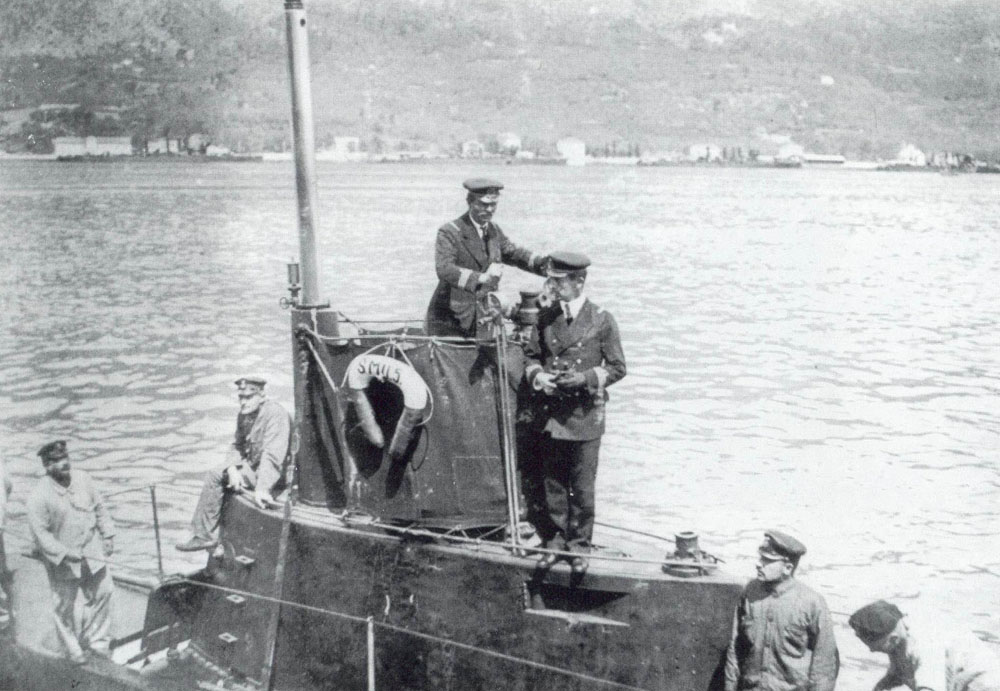
In 1935, Georg von Trapp published a memoir of his service as a submarine captain in the First World War. It must have been written, at least in part, to support the family after the bank failures of the early 1930s depleted their fortune. In her book, Memories Before and After the Sound of Music, Agathe von Trapp recalls that her father frequently delivered public lectures on his experiences as a submarine commander. She adds: "So there was some money to help with the living expenses." Doubtless the book grew out of these talks.
Reading the book today offers a few clues about Georg von Trapp's political views but little foreshadowing of his family's later decision to leave Austria and settle in the U.S. In fact, he expresses hostility to the United States - which was an adversary of Austria-Hungary in the World War.
In April 1916, President Wilson had threatened to sever diplomatic relations with Germany if it did not abandon unrestricted submarine warfare. Wilson said, in an address to Congress:
I have deemed it my duty, therefore, to say to the Imperial German Government that if it is still its purpose to prosecute relentless and indiscriminate warfare against vessels of commerce by the use of submarines, notwithstanding the now demonstrated impossibility of conducting that warfare in accordance with what the Government of the United States must consider the sacred and indisputable rules of international law and the universally recognized dictates of humanity, the Government of the United States is at last forced to the conclusion that there is but one course it can pursue and that unless the Imperial German Government should now immediately declare and effect an abandonment of its present methods of warfare against passenger and freight-carrying vessels, this Government can have no choice but to sever diplomatic relations with the Government of the German Empire altogether.
In a chapter entitled "America Bluffs", von Trapp writes that these actions showed that "President Wilson has openly joined England's side. He wants to eliminate the Central Powers' most dangerous weapon, the U-boats, and with the cheap slogan: 'upholding the most sacred of human rights' he pushes for the safe passage of passenger steamers."
This is not a surprising sentiment coming from a U-boat captain. Throughout the book he expresses frustration with limitations on submarine warfare. Unfortunately for von Trapp, the resumption of unrestricted submarine warfare in 1917 precipitated U.S. entry into the war and undoubtedly hastened the demise of the Central Powers.
It is difficult to characterize von Trapp's attitude to Germany. He is clearly envious of its superior equipment and weaponry. But he also expresses resentment at German criticism of Austrian inefficiency. Toward the close of the book, he recounts a meeting with the Kaiser on his submarine. After telling the Emperor that his crew includes "Germans Hungarians, Italians, Romanians, Slavs [and] Poles," von Trapp adds that "everyone must be able to speak German."
The Kaiser responds "Do you see how important the German service language would be in Austria?"
"I am at a loss for an answer."

No comments:
Post a Comment